The meeting ends well. The question that had been circling for three weeks is finally settled, everyone agrees, and there is that pleasant sense of a thing resolved. Someone says they will pick it up.
Six weeks later it comes up again, and it turns out nothing happened. Not because anyone objected or changed their mind. The decision simply never became work, and nobody noticed the gap between deciding and doing, because deciding felt so much like progress.
Turning decisions into action is one of the most consistent failures in organisations of every size and structure, and it has a small number of causes that are all fixable.
The gap between decisions and action is structural, not motivational
The first thing to say is that this is rarely a commitment problem. The people in that meeting meant it. They were not being casual.
What happened is that a decision and the work it implies live in two different systems, and nothing connects them. The decision was reached in a conversation, a meeting or a document. The work, if it exists at all, lives in a task tracker. The link between them exists only in the memory of whoever was present, and memory is not a system.
Every fix below is really the same fix expressed differently: to turn decisions into action, close the gap between where a decision is made and where work is tracked.
The five reasons, in order of frequency
Nobody was named
"We should do that" and "Sam will do that by Friday" are separated by a small amount of social awkwardness and an enormous amount of outcome.
Groups avoid the naming step because it feels like the collegial mood is being broken by administration, particularly in organisations that pride themselves on not being hierarchical. But a decision without a named owner is a preference, and preferences do not survive contact with a busy fortnight.
The fix is to make naming the last step of deciding rather than an afterthought, and to accept the two seconds of awkwardness as the price. In practice, once a team does this a few times the awkwardness disappears entirely, because everyone can see that the alternative is having the conversation again.
The first step was never defined
Decisions get made at a level of abstraction that cannot be started. "We will move to a quarterly planning cycle" is a decision. It is also not a thing anyone can do on a Tuesday morning.
Between the decision and the work sits a translation step that frequently does not happen: what is the first concrete action, and who does it. Without it, the decision sits in a state of being agreed and unstartable, and it will stay there indefinitely because there is nothing to fail to do.
There was no deadline, so it competed badly
Work with a date beats work without one, every time, regardless of importance. This is not a failure of prioritisation; it is how attention allocates under load.
A decision that produces undated work is entering a queue where it will lose to everything dated, permanently. Even an arbitrary date, openly acknowledged as arbitrary, changes this substantially.
The decision was never visible outside the room
Four people decided. The two people who would have to do most of the resulting work were not there and found out obliquely, weeks later, in a form that sounded more like a rumour than a commitment.
This is the version that produces resentment as well as inaction. The people affected experience it as being handed work they had no part in agreeing, which is a reasonable reading, and their compliance is correspondingly low.
Nothing tracked whether it happened
The most fundamental. If nothing in the organisation notices the difference between a decision that was implemented and one that was not, then the two are, operationally, the same thing.
In a management structure a person does this noticing. Remove the management layer without replacing the function and no noticing occurs at all, which is why this pattern is often worse in flat organisations than in hierarchical ones.
The gap | What closes it |
|---|---|
No owner | Naming is the final step of deciding, not a follow-up |
Too abstract to start | Define the first concrete action before closing |
No date | Attach one, even an arbitrary one |
Invisible to the people affected | Decisions published where affected people already look |
Nothing tracks it | The decision and the work are linked objects, not separate ones |
The closing ritual that turns decisions into action
One change, applied consistently, addresses four of the five. Before a decision is considered closed, the group answers three questions out loud:
What is the first action, who is doing it, and by when.
That is it. Thirty seconds. It converts an agreement into a commitment, and it does so at the only moment when everyone with the context is present and paying attention. Every attempt to do this later is reconstruction.
The three answers belong in the decision record alongside what was decided and why. A decision record that captures reasoning but not the resulting action is only half a record, and it is the half that describes the past rather than the half that shapes the future.
Why this works better than a follow-up process. Most organisations try to fix this downstream, with a review meeting that checks whether previous decisions were implemented. Those meetings are useful and they are also a symptom: they exist because the link was not made upstream, and they cost far more than the thirty seconds would have.
When failing to turn decisions into action means something else
Two situations where the pattern is telling you something else, and applying the ritual above will not help.
If decisions consistently fail to turn into action in one particular area, the likely cause is that the person who has to do the work was not entitled to be part of the decision, or does not agree with it and did not have a route to say so. That is a decision rights problem, and the inaction is a symptom of a governance gap rather than an execution one.
And if a great many decisions are being made and few are being implemented across the board, the organisation may simply be deciding faster than it can do. That is a capacity problem masquerading as a follow-through problem, and the fix is deciding less rather than tracking more.
The infrastructure version
You can run the closing ritual with any tools and enough discipline. Many teams do, and it works until a busy month, because the link between the decision and the work exists in a habit rather than in the system.
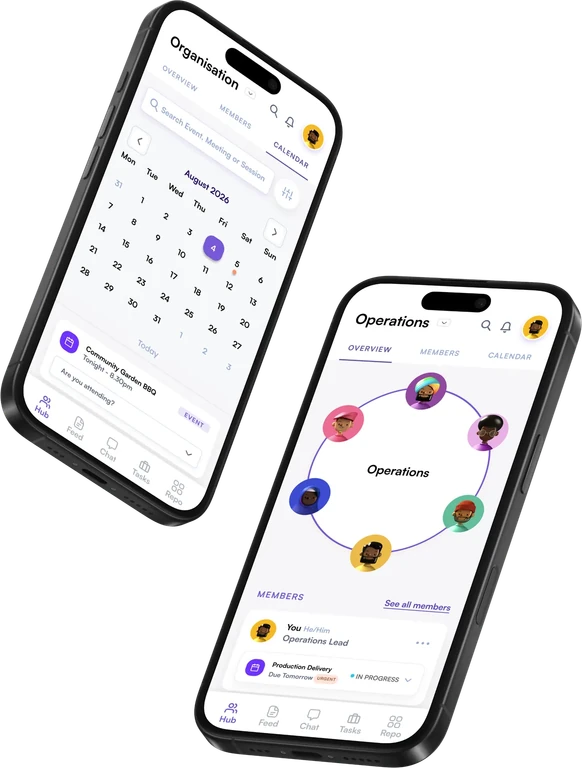
The structural version is that a decision and the work it creates are connected objects rather than two records in two places. In Autono, a decision reached in a session produces its own record, and the tasks and responsibilities arising from it are linked to that record. Anyone can follow a decision forward to see whether it happened. Anyone looking at a piece of work can follow it back to the decision that authorised it.
That connection is what makes follow-through observable without anybody chasing, which matters most in exactly the organisations that have deliberately removed the people who used to chase.
If your team decides well and implements unevenly, the gap is probably not in your people. Get started with Autono, or request a demo if you would rather be shown what it looks like when the two halves are joined.
Two related pieces: task, responsibility or role on why ongoing commitments dissolve into task lists, and who should assign the work on what changes when nobody allocates.