Most teams start looking for an encrypted Slack alternative after one realisation: Slack is not end-to-end encrypted, has never claimed to be, and has said publicly it has no plans to be.
That is not a security failing. Slack encrypts data in transit with TLS and at rest with AES-256, holds the usual certifications, and offers Enterprise Key Management on Enterprise Grid so large customers can supply their own keys. But EKM is not end-to-end encryption. It gives you control over keys and the ability to revoke access. It does not mean Slack is technically unable to read message content. For most organisations that distinction never matters. For some it matters a great deal.
This is a guide to the encrypted Slack alternative options that exist, what each genuinely offers, and what end-to-end encryption costs you in return.
First, work out which problem you have
Three quite different concerns get filed under "we need encrypted chat", and they have different answers.
Confidentiality against the provider. You do not want the vendor to be technically capable of reading your messages. This is what end-to-end encryption actually addresses, and it is the right frame for journalism, legal work, activism, sensitive negotiations, healthcare and any organisation whose members would be harmed by disclosure.
Data sovereignty and jurisdiction. Your concern is where data physically sits and which government could compel access. This is usually solved by EU or in-country hosting, or by self-hosting, rather than by E2EE.
Control, attribution and auditability. You want to know who decided what, under what authority, and to be able to demonstrate it. This is a governance requirement, and it is the one most organisations distributing authority actually have.
Choosing an E2EE tool for a sovereignty problem, or a self-hosted tool for a confidentiality problem, is a common and expensive mismatch. Be specific about which one you have before shortlisting. And note that the third concern is not served by encryption at all, which is the point most comparison articles miss.
The encrypted Slack alternative options worth knowing
Tool | E2EE | Self-hostable | Notes |
|---|---|---|---|
Element (Matrix) | Yes, default in private rooms | Yes | Open protocol, adopted by several European governments. Most complete Slack replacement in the E2EE category |
Wire | Yes, default | Yes, enterprise | European, MLS-based encryption, strong government and regulated-sector use |
Threema Work | Yes, default | No | Swiss, no phone number or email required, strong on data minimisation |
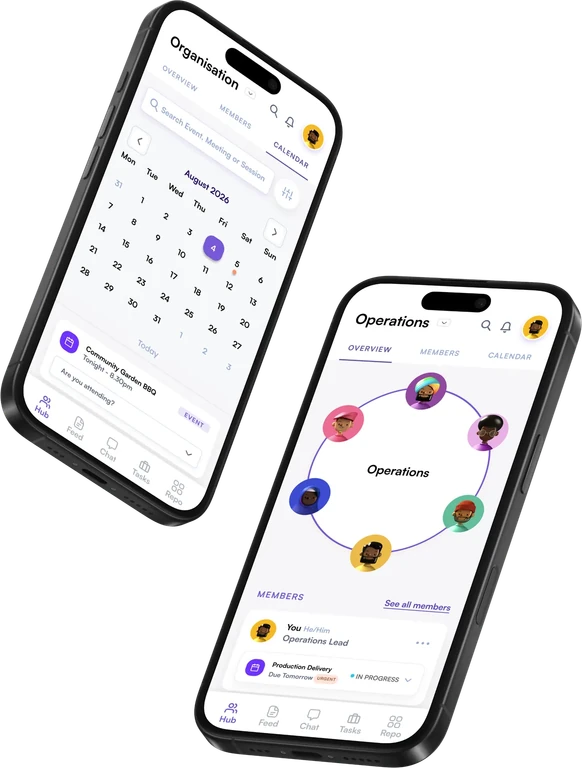
Autono | Yes, default in Chat | No | Encrypted messaging with threads and channels, plus the governance layer around it: threads link to the decisions, tasks and documents they produced. The only option here that treats the decision record as a first-class object |
Rocket.Chat | Optional, per-channel | Yes | Open source and highly configurable. E2EE is off by default and disables server-side search where enabled |
Mattermost | No native E2EE | Yes | Security comes from self-hosting and control, not from encryption. Popular with engineering teams |
Wickr | Yes | Enterprise tiers | Now part of AWS, strong in defence and government |
Signal | Yes, default | No | The reference standard for the protocol, but built for individuals rather than organisations. Limited administration |
Element and Matrix
The strongest candidate if you want a like-for-like Slack replacement with E2EE on by default and no vendor lock-in. Matrix is an open protocol rather than a product, so you can self-host, federate with other organisations, and move between clients.
The trade-offs are real. Self-hosting Matrix properly requires operational capability. The interface, while much improved, still asks more of non-technical members than Slack does. And device verification, which is what makes the encryption trustworthy, is a concept most people have never had to think about.
Wire
More polished than Element and correspondingly less flexible. European, encrypted by default, with a strong record in government and regulated industries. If you want E2EE without running infrastructure, this is usually the shortlist entry.
Rocket.Chat and Mattermost
Both open source, both self-hostable, and both recommended in this category with insufficient qualification. Mattermost has no native end-to-end encryption; its security proposition is that you run it, so nobody else holds the data. Rocket.Chat offers E2EE but not by default, and encrypted channels cannot be searched server-side.
If your concern is jurisdiction, self-hosting either is a reasonable answer. If your concern is that no third party should be technically able to read messages, Mattermost does not give you that and Rocket.Chat gives it only where you switch it on.
Autono
Encrypted messaging with threads and channels, built as part of a governance platform rather than as a standalone messenger. Messages are end-to-end encrypted from sender to receiver, and conversations are not mined or used as training data.
What distinguishes it in this list is not the encryption, which several of these do well, but what sits around it. A thread links to the proposal it concerns, the decision it produced and the task that followed. That connection is the thing every other tool in this table leaves to human discipline, and it is the reason a decision made in Autono is still findable two years later.
The honest limitations: it is not self-hostable, it is a newer product than most of the others here, and enterprise certifications and EU data residency are on the roadmap rather than in place today. If you are running a procurement process with hard requirements in those areas, ask us about timing before planning around us.
The trade-off nobody puts on the comparison page. End-to-end encryption means the server cannot read your messages, which means it cannot search them, index them, run compliance tooling over them, or recover them when someone loses every device. Organisations with legal retention or eDiscovery obligations frequently discover this after migrating. Resolve those obligations before choosing, not after.
What migrating actually costs
Worth budgeting honestly for, because the tool comparison is the easy part.
Integrations are the biggest hidden cost. Slack's value for many teams is less the chat than the fifty things that post into it. Every encrypted alternative has a smaller ecosystem, and E2EE makes some integrations structurally impossible, because a bot that cannot read the channel cannot respond to it.
Search degrades in encrypted channels by design. Teams that rely on chat as an informal archive feel this immediately, and it is usually the complaint that surfaces in month two.
Adoption is slower. Device verification, key management and the occasional undecryptable message are unfamiliar to people who have only used consumer messaging, and the support burden lands on whoever championed the move.
None of these are reasons not to migrate. They are reasons to migrate for a clearly identified need rather than a general sense that more encryption would be better.
The question worth asking before you migrate
A pattern worth naming, because it comes up often enough to check against.
A team goes looking for an encrypted Slack alternative. When you ask what triggered it, the answer is frequently not an interception concern. It is that something significant was decided in chat, nobody could find it later, and the resulting discomfort attached itself to the tool. The security review became the vehicle for a different frustration.
If that describes your situation even partly, encryption alone will not help. An encrypted Slack alternative has exactly the same properties that made the decision unfindable in the first place: ordered by time rather than topic, no completion state, reasoning separated from conclusion, everything weighted equally. You will have moved the problem into a more private container.
This is the gap Autono was built to close, and it is why we are in the table above rather than writing about it from outside. Chat is encrypted and organised by thread and channel, so the conversation stays private and in context. But threads connect to the decisions and tasks they produce, so when the conversation ends the reasoning does not go with it. The record is a by-product of working, not a discipline someone has to remember.
If your team needs both privacy and a record it can rely on, get started with Autono, or request a demo if you would rather be walked through it.
For more on the findability half of this problem, see how to stop decisions getting lost in chat. Also in this series: how to organise your team channels.