
Bottom-up project management for
self-organising teams
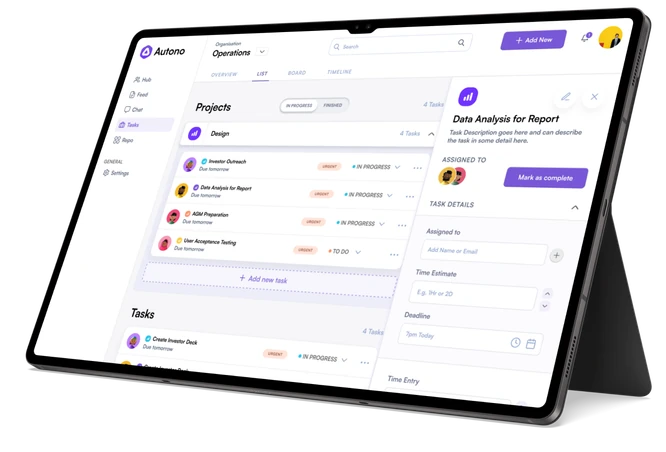
Autono Tasks is simplified task management for self-organising teams. Lists, Kanban boards, and Gantt timelines that work the way autonomous teams actually work. Bottom-up, not top-down.
“Most project management tools were built for command-and-control. Someone assigns, someone tracks, someone reports upward. What if there was a better way to work?”
 Joseph ChanCo-Founder of Autono
Bottom-up by design
Tasks gives self-managing teams the structure to coordinate without the hierarchy to control. Tasks can be initiated by anyone. Ownership is claimed, and accountability is visible to everyone, not just the person at the top. This trusts your team to figure it out and to organise themselves.
Task Lists
Simple, flexible task lists that anyone can create, own, and share. No admin rights required. No bottlenecks. Just clarity about what needs doing and who's doing it.
Projects
4 Tasks
Design
4 Tasks
IN PROGRESS
URGENT

Investor Outreach
Due tomorrow
IN PROGRESS
URGENT

Data Analysis for Report
Due tomorrow
IN PROGRESS
URGENT

AGM Preparation
Due tomorrow
TO DO
URGENT

User Acceptance Testing
Due tomorrow
Add new task
Tasks
4 Tasks
IN PROGRESS
URGENT
Create Investor Deck
Due tomorrow
IN PROGRESS
URGENT
Create Investor Deck
Due tomorrow
IN PROGRESS
URGENT
Create Investor Deck
Due tomorrow
IN PROGRESS
URGENT
Create Investor Deck
Due tomorrow
Backlog
4 Tasks
To Do
4 Tasks
4 Nov
0
0
URGENT
TAGS
Task Name
Description
4 Nov
0
0
URGENT
TAGS
Task Name
Description
4 Nov
0
0

URGENT
TAGS
Task Name
Description
4 Nov
0
0

URGENT
TAGS
Task Name
Description
4 Nov
0
0
URGENT
TAGS
Task Name
Description

Closing & SOW
S 31
M 1
T 2
W 3
T 4
F 5
S 6
S 7
M 8
T 9
W 10
T 11
F 12
S 14
M 15
T 16
T 17
F 18
S 19
S 13
S 20
M 21
T 22
W 23
T 24
F 25
26
27
Aug 2025
Title
Duration (Working Days)
UX Research

UX Design

UI Design
Outreach
Pitching
UX Research
UX Design
UI Design
8 Days
Investor Outreach
Pitching
Closing & SOW
5 Days
5 Days
Design
8 Days
5 Days
3 Days
Sales & Marketing
Development
Sales & Marketing
Development
Design
Simplified Task Management for Self-Organising Teams
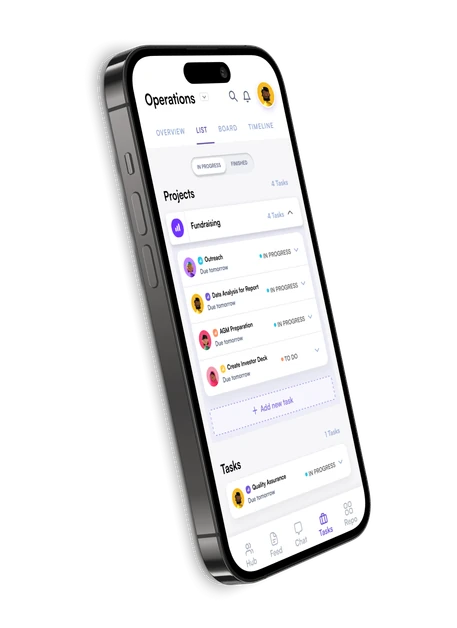
Lists, Kanban boards, and Gantt timelines that work the way autonomous teams actually work. It makes ownership visible, progress transparent, and blockers obvious, so teams can solve problems together instead of waiting for permission.
Insights for Progressive Orgs, Leaders & Changemakers



Frequently Asked Questions
The questions teams ask most often about Tasks, answered directly.
Bottom-up project management is an approach where the people doing the work initiate, scope and claim it, rather than receiving it from a manager who plans on their behalf. Coordination comes from shared visibility and clear roles instead of from an assignment chain.
Nobody assigns it; people claim it. Work attaches to a role rather than being handed to a person, so the question of whose it is has a structural answer. Anyone can propose work into a queue, claiming it is an explicit and visible act, and unclaimed work surfaces as a signal rather than rotting quietly.
A task is a single piece of work with an end. A responsibility is an ongoing commitment to keep something in good order. A role is a named bundle of responsibilities that a person holds. Most confusion about ownership comes from treating all three as the same thing.
Yes. Lists, Kanban boards and Gantt timelines are all available, and they are views of the same underlying work rather than separate tools. The difference from conventional project software is not the board, it is who is allowed to put something on it.
Those tools assume someone assigns and someone reports. Remove the manager and they do not break, they go quiet, and the team reinvents a manager to clear the queue. Autono routes work through roles instead, and connects it to the decision that authorised it.