
Knowledge that survives people leaving
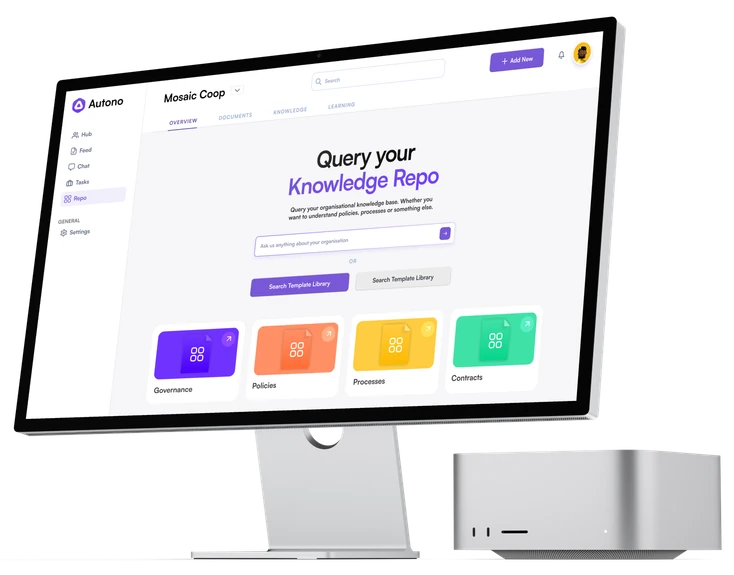
Autono Repo is the organisational brain: a searchable repository for governance documents, policies, processes, contracts, articles, FAQs, training courses, and onboarding guides. Enterprise search built in. Institutional knowledge preserved as teams evolve.
“Your organisation’s most valuable asset is the accumulated wisdom of how you actually work. When the knowledge holders leave, the knowledge leaves with them. This is a huge problem.”
 Joseph ChanCo-Founder of Autono
Searchable, structured & built to survive turnover
Repo is where institutional knowledge stops living in people’s heads. Policies, processes and governance documents are written by the people who actually know them, and found by asking a question rather than remembering which folder it was in. When someone leaves, what they knew stays.
Documents & Agreements
Policies, processes, contracts. The paperwork that keeps your organisation running, in one searchable place. Not buried in a shared drive nobody can navigate, a wiki last updated in 2023, or the head of someone who's just handed in their notice.

TRAINING COURSE
Running Events Training
This training will show you how to run community events and how to promote it effectively as well.

TRAINING COURSE
Inventory Training
This training will get you started at Mosaic Coop community cafe and how to use the inventory.

ONBOARDING GUIDE
Getting Started 101
This is a guide to getting started at Mosaic Coop and what to expect over your first week here.
Query yourKnowledge Repo
Query your organisational knowledge base. Whether you want to understand policies, processes or something else.
Ask us anything about your organisation
YOU
What are the key things I need to know about my rights and responsibilities as a member?
As a member you have the right to vote on major decisions, attend General Meetings, and access all governance documents. You are responsible for upholding our Code of Conduct and contributing to collective working practices.
CITATIONS:
Code of Conduct
Start building your org’s brain that will outlast any single person
Stop letting your organisation’s memory walk out the door. Build a searchable governance repository for policies, processes, contracts, and institutional knowledge. Enterprise search built in. Built for teams that need memory that survives turnover.
Insights for Progressive Orgs, Leaders & Changemakers



Frequently Asked Questions
The questions teams ask most often about Repo, answered directly.
A governance handbook is the written record of how an organisation actually runs: who holds which roles, what each role is allowed to decide, how decisions get made, and what happens when they are disputed. It is the document a new joiner should be able to answer their own questions from.
By making the written record a by-product of ordinary work rather than a separate documentation project. Decisions, roles and processes are captured where they happen and stay searchable afterwards, so what someone knew is in the organisation rather than only in their head.
That is the intent. If roles, decision rights, processes and past decisions are all written down and findable, a new joiner can answer most of their own questions in the first fortnight instead of consuming a colleague’s week. Self-serve onboarding is a test of the handbook, not of the joiner.
Those are excellent blank pages, and the usual failure is not the tool but that documentation drifts out of date because nothing connects it to the work. The Repo is connected to the roles, decisions and tasks it describes, so the record moves when the organisation does.
Yes, and by question rather than by folder. The test we design for is that someone can ask what they actually want to know, in their own words, instead of having to remember who filed it and where. Remembering the filing structure is what stops people using documentation.