Onboarding in most organisations is a person. A manager who explains how things work, a buddy who answers the awkward questions, and a slow accumulation of context gathered by asking.
Remove the manager and that model has nothing underneath it. The new joiner arrives into an organisation with no line manager to orient them, a set of colleagues who are all busy, and a general encouragement to ask anyone anything, which sounds welcoming and is in practice a request that they work out both the questions and who to ask.
Self-serve onboarding is what replaces it. Done properly it is not a lesser version of manager-led onboarding; it is faster and more consistent, because it does not depend on how good any individual is at explaining. Done badly it is abandonment with a documentation link.
What self-serve onboarding actually has to do
Four jobs, and they are not equally well served by documentation.
Orientation. Where things are, what the organisation does, how the week works. Documentation handles this well.
Permission. What this person is allowed to do, decide and change. Documentation handles this well and almost nobody writes it down.
Connection. Who to work with, who holds what, who to go to for a given kind of problem. Documentation handles this partially; it needs a structural component.
Belonging. Whether this is a place they want to stay. Documentation does not handle this at all, and no self-serve system should pretend otherwise.
That fourth point is the honest caveat. Self-serve onboarding removes the dependency on a manager for the first three. It does not remove the need for human contact, and organisations that treat "no managers" as "no onboarding people" produce three-month attrition.
Week one: what a new joiner must be able to find alone
The test for a self-serve system is whether a new person can answer these without asking anybody. Most organisations fail on the middle three.
What am I here to do? The role they hold, the responsibilities it carries, and how it connects to what the organisation is trying to achieve. Written as the role rather than as a job description, so it stays true when the person changes.
What can I decide? The single most important and most commonly missing item. A new joiner who does not know their decision rights will default to asking permission for everything, which recreates a management layer out of nothing but uncertainty. Making this explicit on day one is the highest-return thing in the whole process.
Who holds what? Not an org chart, a role directory. When something needs a decision they do not hold, they need to know whose it is, and "ask around" is a poor answer to give someone with no relationships yet.
Why is it like this? The handful of decisions that shaped how the organisation currently works. This is the context a manager would have transmitted in conversation, and it is what stops a new joiner spending six months confused by arrangements that have perfectly good reasons behind them. A readable decision log does this better than any onboarding document, because it is already being maintained for other reasons.
What is happening right now? Current initiatives, live proposals, what the organisation is deciding this month. Nothing makes a new person feel peripheral faster than discovering a significant thing three weeks after everyone else.
The uncomfortable diagnostic. Give your onboarding materials to someone who joined four months ago and ask them to mark every question they had in week one that the materials do not answer. The list is usually long, and it is almost entirely made up of things nobody thought to write down because everyone already knew them.
The four artefacts you actually need
Self-serve onboarding does not require a large system. It requires four things that are current.
Artefact | What it answers | Owner |
|---|---|---|
Role definition | What am I here to do and what can I decide | The role's holder or the team |
Role directory | Who holds what across the organisation | Whoever maintains the role structure |
Decision log | Why things are the way they are | Produced by deciding, not written for onboarding |
Governance handbook | How things work here, how to change them | A named owner per section |
Three of those four should exist anyway for other reasons, which is the point. Self-serve onboarding is mostly not a separate project. It is a consequence of an organisation that has already made its roles, decisions and rules explicit, and organisations that have done that find onboarding largely solves itself.
The role handover, which replaces the manager
The one thing self-serve onboarding does need that is specific to it.
In a management structure, a manager holds the knowledge of what a person is picking up. Without one, that knowledge has to transfer directly, and the most reliable mechanism is a structured handover from the previous holder of the role, or from whoever has been covering it.
A handover covers four things: the responsibilities being transferred, the decisions currently in flight, the relationships the role depends on, and the things the previous holder would warn them about. That last item is the one nobody documents and the one that saves the most time.
Where a role is genuinely new, the handover comes from whoever proposed creating it, and covers what problem it exists to solve. A role with no articulable problem behind it is worth questioning before someone is hired into it.
What to keep human
Being clear about the limits, because self-serve onboarding oversold produces bad outcomes.
Someone should be explicitly responsible for the new person's first month. Not a manager, and not a mentor in the developmental sense, but a named person whose responsibility is that this individual is not lost. In role-based organisations this is often a rotating responsibility rather than a permanent one.
Early work should be deliberately chosen rather than pulled. A pull system assumes someone can judge their own fit, and a new joiner cannot. Two or three pushed pieces of work in the first fortnight, with the reasoning said out loud so it does not look like a return to allocation, is worth a great deal.
And there should be a scheduled point, around week three, where someone asks what is still confusing. New people stop asking questions long before they stop having them, usually because they have concluded that the confusion is their own fault.
Measuring whether it works
Two numbers, both easy to collect.
Time to first independent decision. How long before the new person makes and records a decision within their own authority, without checking. This measures whether permission was actually transferred, which is the thing self-serve onboarding most often fails at.
Question volume in week three. If it is high, the materials are incomplete. If it is near zero, that is not success, it is usually someone who has given up asking. The healthy pattern is a decline from week one to week three, not a cliff.
The version that maintains itself
The reason onboarding documentation goes stale is that it is written for onboarding and used only at onboarding, so nothing surfaces its inaccuracy in between.
The version that stays current is one where onboarding is a view onto things the organisation maintains anyway: roles that are current because people use them daily, decisions that are recorded because decisions are being made, a handbook that updates when a decision changes it.
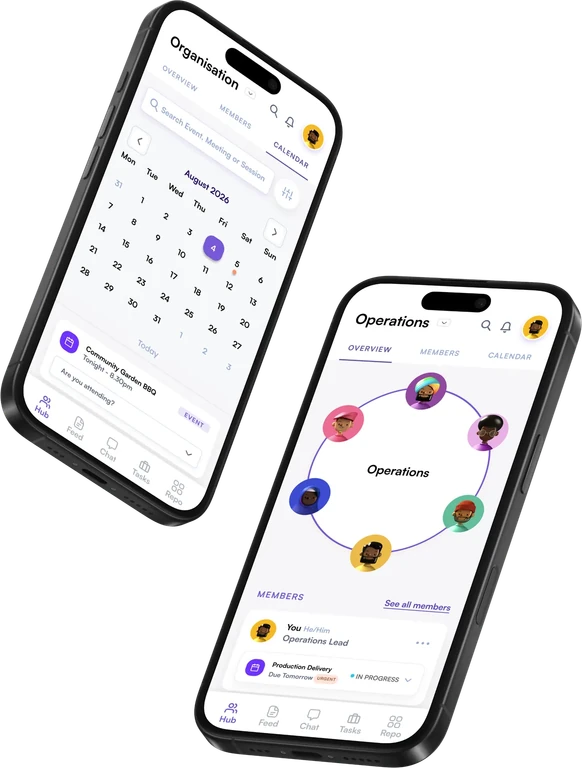
That is how Autono's Repo and Hub work together. The Repo holds the courses, guides and FAQs that get someone productive without a senior colleague walking them through everything, with enterprise search over all of it. The Hub shows them their role and its authority, who holds what, and what is currently open. None of it was written specifically for them, which is exactly why it is current: it is the organisation's live record rather than an onboarding artefact.
For organisations distributing authority to the teams closest to the work, that matters more than it does elsewhere, because a new person who does not know what they may decide will wait, and waiting is exactly what the structure was designed to remove.
If your onboarding depends on people who no longer exist in your structure, we would like to help. See how it works in practice: request a demo.
Two companion pieces: how to structure a governance handbook people read, and why doesn't anyone use our documentation.