Ask five people in an organisation who is responsible for keeping the supplier list current, and you will get five answers with a common structure. Somebody did it last time. Somebody probably ought to. It is sort of part of what the operations person does. It was on a list once.
None of those is a responsibility. Roles and responsibilities are being confused with tasks here, and they are memories of tasks, which is a different thing, and the confusion between the two is where most accountability quietly leaks out of an organisation.
Roles and responsibilities, defined against tasks
A task is a discrete piece of work with a defined end. It is done or it is not. "Update the supplier list for Q3" is a task. Tasks are completed and then they are finished.
A responsibility is an ongoing commitment to an outcome, with no end state. It is held rather than completed. "Keep the supplier list current" is a responsibility. Somebody holds it continuously, and the tasks it generates come and go.
A role is a named position that holds a set of responsibilities and carries defined authority. It is filled rather than held or completed. "Supplier Relations" is a role. It exists independently of whoever occupies it, and it can be handed to someone else without renegotiating what it means.
The relationship runs downward. A role holds responsibilities. A responsibility generates tasks. A task is done by a person.
Why confusing roles and responsibilities is expensive
Each conflation produces a specific failure that most people will recognise.
Treating a responsibility as a task
The commonest. Someone does a piece of ongoing work as a one-off, it gets ticked, and the ongoing part vanishes. Six months later nobody has done it since, and nobody realises, because there is no open item to notice.
This is how organisations accumulate things that were once maintained and now are not: the supplier list, the onboarding docs, the access review, the licence renewals. Nobody dropped a responsibility. There was never a responsibility, only a series of tasks that happened to stop.
Treating a role as a person
"Ask Priya, she handles that." Everyone knows this and nobody wrote it down, so when Priya leaves, so does the role, and what remains is a series of increasingly puzzled conversations about who used to do the thing.
A role that exists only as shared knowledge about a person is not a role. It is a dependency.
Treating a task as a responsibility
Less common and worth naming. Assigning someone an ongoing responsibility for something that is genuinely a one-off produces a permanent low-grade obligation nobody can ever discharge. People end up carrying a list of things they are notionally responsible for and cannot finish, which is corrosive in a way that a long task list is not.
The diagnostic question. For any piece of work, ask: when is this done? If there is an answer, it is a task. If the honest answer is "never, it just needs to stay true", it is a responsibility and it needs a holder rather than a due date. Getting this one distinction right removes a surprising amount of the drift in an organisation.
How this differs from responsibility versus accountability
This gets confused with a related question, so worth separating.
The responsibility-versus-accountability distinction, which HR writing covers extensively, is about who does the work versus who answers for the outcome. It is a useful distinction and it is not the one being drawn here.
The task, responsibility and role distinction is about the shape and duration of the commitment, not about who owns the consequence. A responsibility in this sense can be held by the person who does the work and by the person who answers for it, which are frequently the same person in a self-managing team.
Ends? | Held by | Fails when | |
|---|---|---|---|
Task | Yes, on completion | A person, once | It is actually recurring |
Responsibility | No | A role, continuously | Nobody holds it, or a person holds it rather than a role |
Role | Filled, not ended | A person, for now | It exists only in people's heads |
Why this matters more without managers
In a conventional hierarchy, these distinctions can stay implicit because a manager holds them. They know that the supplier list is an ongoing thing, that Priya does it, and that if Priya goes it needs reassigning. The organisation's memory of its own commitments lives in a layer of people.
Remove that layer, and nothing holds the distinctions unless they are made explicit. This is the single most under-anticipated consequence of flattening an organisation: not that decisions get harder, but that the connective knowledge about who is committed to what continuously simply evaporates.
Which is why self-managing organisations tend to be more explicit about roles and responsibilities than hierarchical ones, not less. Holacracy, sociocracy and most role-based systems put enormous weight on defining roles precisely, and it can look like bureaucracy from outside. It is the opposite. It is what replaces the bureaucracy of a management layer that used to hold the same information informally.
A role definition that works needs four things: a name, the responsibilities it holds, what it is entitled to decide without asking, and who currently fills it. That fourth element changes; the other three should not change often. Making decision rights part of the role definition is what turns a job title into something operationally useful.
A practical exercise
If you want to see the state of this in your own organisation, this takes an hour and produces uncomfortable clarity.
Take your team's list of everything currently being worked on. For each item, sort it into task, responsibility or role. Most lists conflate roles and responsibilities with one-off work throughout. Most teams find three things.
A significant number of items are responsibilities being managed as tasks, cycling through the list repeatedly and never being finished. These should be lifted out and given a holder.
A handful of things nobody can categorise, because they are habits rather than commitments. These are the ones most likely to disappear silently.
And several responsibilities that map to no role at all, which is the useful finding. An unheld responsibility is an organisational risk sitting in plain sight, and it is usually the third or fourth one on the list that makes people uncomfortable.
Diagram showing a role holding several responsibilities, each generating tasks over time
The hierarchy that most tools flatten into a single list. A role holds responsibilities; responsibilities generate tasks; tasks end and responsibilities do not.
Why most tools flatten this
Almost every project management tool has one primitive: the task. Roles and responsibilities are just tasks with labels on them. A recurring task is a task with a repeat setting. A responsibility is a task that keeps coming back. A role is, at best, a group you can assign to.
For a team where a manager holds the real structure in their head, this is fine. The tool is a list and the manager is the model.
For an organisation distributing authority, it is not, because the model has to be in the system if it is not in a person. A recurring task with a repeat setting is not the same as a named holder committed to an outcome, and the difference shows up precisely when things go wrong: a missed recurrence generates an overdue item, while an unmet responsibility generates a conversation with the person who holds it.
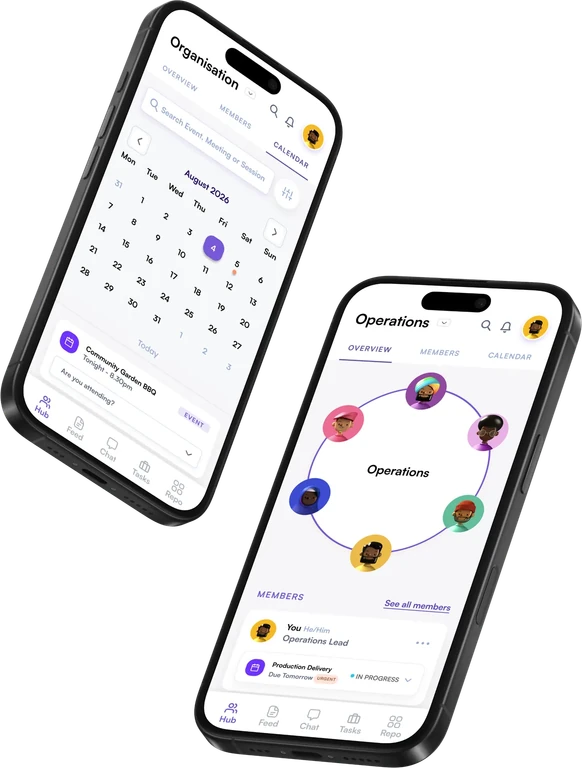
Autono treats these as genuinely different objects. Tasks are discrete work. Responsibilities are held continuously. Roles carry responsibilities and the authority that comes with them, and they persist when the person filling them changes. All three are visible in the Hub, alongside each member's skills and interests, so matching a person to a piece of work is a lookup rather than a guess. That is not a taxonomy for its own sake; it is what lets an organisation know what it is committed to without a management layer remembering on its behalf.
If your team's ongoing commitments keep dissolving into a task list, we would like to show you the alternative. Get started with Autono.
For how this plays out in day-to-day allocation, see who should assign the work. For what happens when a decision produces no work at all, see why our decisions never turn into action. The full set of terms is in the governance glossary.