Three hundred members on the register. Forty at the general meeting, and thirty of those are the people who always come. The motions pass. The accounts are approved. Somebody raises the same concern about communication that was raised last year, and everybody nods, and nothing about the pattern changes.
Or the corporate version: an employee-owned business where ownership is real, the trust is properly constituted, and if you asked people what decisions they had influenced in the past year most would struggle to name one.
This is the low member engagement problem, and it is worth being precise about what it is. It is not apathy. The people on that register joined a co-operative, took shares in their employer, or volunteered their time, which is a strong signal of intent. Something between that intent and their participation is broken, and in most organisations it is not the members. It is that participating costs more than it returns, and a member portal is the most direct way to change that arithmetic.
What member engagement actually means
Worth separating from two things it gets confused with.
It is not satisfaction. A member can be perfectly content and entirely passive, and organisations that measure satisfaction often miss a slow drift into disengagement because the numbers look fine right up until the point somebody needs a quorum.
It is not attendance. Turning up to a meeting is a proxy that made sense when meetings were the only mechanism, and it systematically undercounts the people who care but cannot be in a room at seven on a Tuesday.
Member engagement is the extent to which members actually shape what the organisation does. That definition has an uncomfortable implication: an organisation can have excellent communications, high satisfaction and full meetings, and still have low member engagement, because none of those things involve members changing an outcome.
The four reasons member engagement drops
In our conversations with co-operatives, employee-owned businesses and membership organisations, the same four causes of low member engagement come up. All of them are structural, which is the good news, because structural problems are fixable and apathy is not.
Participation is priced in a currency most members do not have
The default mechanism for member involvement is a meeting. Meetings require being in a specific place at a specific time, which excludes shift workers, carers, part-time members, people in other timezones and anyone whose life does not have a reliable free evening.
So the members who participate are the members who can, and over time the organisation mistakes availability for interest. Measured this way, member engagement is really a measure of who has free evenings. The quiet majority are not disengaged. They are priced out, in hours.
Nothing is visible between the big moments
Most membership organisations communicate in a rhythm of large, infrequent events: an AGM, a quarterly update, an annual report. Between them the organisation is essentially invisible to its members.
That invisibility is what makes participation feel abrupt. A member who has heard nothing for four months is handed a set of resolutions and asked to vote on them, and the honest response to that is to abstain or defer to whoever seems informed. Which is exactly what happens, and it looks like disinterest.
Contributing last time changed nothing observable
The most corrosive of the four. If a member raised a point, or voted, or answered a survey, and nothing visibly followed, they have learned something specific about how much their participation matters.
That lesson generalises quickly and it lasts for years. Organisations frequently work very hard on the next consultation without ever addressing why the previous one taught people not to bother.
Members do not know what they are entitled to decide
Underrated and very common. Ask members of a co-operative which decisions are theirs, which are the board's, and which are operational, and you will get a wide spread of answers, most of them uncertain.
Uncertainty produces silence. A member who does not know whether something is their business will not raise it, and the organisation reads that silence as consent.
The diagnostic worth running. Take a decision your organisation made in the last quarter that genuinely affected members. Ask five members, separately, whether they knew it was being decided, whether they knew they could have had a say, and where they would have gone to have one. The answers usually make the problem concrete faster than any engagement survey.
How a member portal addresses each one
A member portal is not member engagement software in the sense of pulse surveys and recognition badges. What it does is remove each of the four structural blockers, which is a less exciting claim and a much more durable one.
The blocker | What the portal changes |
|---|---|
Participation requires being present | Proposals and consent rounds run over days, from a phone, at whatever hour suits |
Nothing visible between events | The organisation's live decisions and open questions are permanently on view |
Contributions vanish | The decision record shows what was raised, what was decided and why |
Members do not know their rights | Roles and decision rights are published, so entitlement is legible |
It moves participation off the calendar
The single largest gain. When a proposal runs asynchronously over five days rather than in a two-hour meeting, the population able to participate expands enormously. The care worker on a late shift, the member with young children, the person who needs an hour to think before responding rather than thirty seconds to react.
This is not merely a convenience improvement. It changes who the organisation hears from, and organisations consistently report that the views arriving from newly included members are different from the views they were getting before.
It makes the organisation continuously visible
A portal that shows what is currently open, what was recently decided and what is coming replaces the four-month silence with a low, steady signal. Members do not have to read it daily; they have to know it is there when they wonder.
That changes the texture of the big moments too. An AGM attended by people who have been able to see the organisation all year is a different meeting from one attended by people encountering the information for the first time.
It closes the loop where members can see it
The mechanism that rebuilds trust after it has been lost. When a member raises an objection and can later see the decision, the reasoning, and whether their point changed anything, participation stops feeling like shouting into a void.
The cases where the objection did not prevail matter most here. A member whose concern was considered and answered with a reason will participate again. This is why an auditable decision log does more for member engagement than most features designed for engagement, and why we treat it as core infrastructure rather than a governance nicety.
It makes entitlement explicit
Publishing roles and decision rights where every member can see them removes the uncertainty that produces silence. A member who knows a given question is theirs to weigh in on is far more likely to do so than one who suspects it might be somebody else's business.
What to measure
Three numbers that reflect what is actually happening, none of which are logins.
Breadth of participation. The percentage of members who contributed anything at all in the last quarter. This is the honest member engagement number and it is usually much lower than organisations expect, because attendance and satisfaction have been standing in for it.
Participation gap. The difference in participation rates between members who work at a desk and members who do not. A wide gap means your access problem is still an access problem, whatever the portal looks like.
Loop closure time. How long between a member contributing and that member being able to see what happened as a result. This is the number most directly within your control and the one that moves the other two.
Where to start
Not with a launch. Take one decision your organisation genuinely has not made yet, and run it in the portal, in the open, over a week, with every member able to see it and respond.
One real decision will teach you more than a quarter of member engagement planning. It will show you immediately whether your members can actually participate from where they are, whether the entitlements are clear, and whether the loop closes. And unlike a campaign, it produces something: a decision, made with more of the organisation involved than usual, with a record that proves it.
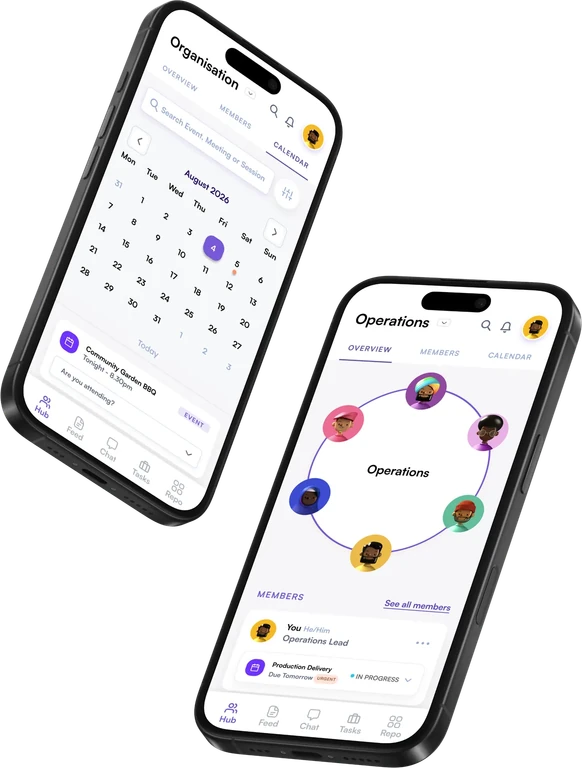
Autono was built for organisations where participation is meant to be real rather than symbolic. The Hub gives every member, not just managers, a mobile-first view of what matters to them: their roles and responsibilities, what the team is deciding, and what needs their input today. Async sessions mean participation does not depend on being free on a Tuesday evening. And an auditable decision log shows members that their contribution mattered. If your register is long and your participation is thin, we would like to help you close that gap. See how it works in practice: request a demo.
For what should actually sit in the portal once you have one, see what belongs on a member portal. If your members are also your workforce, bottom-up project management covers the day-to-day side of the same shift.