Every description of bottom-up project management eventually reaches the sentence "the team decides what to work on", and stops there. Which is unhelpful, because that sentence describes an outcome rather than a mechanism, and the interesting question is what has to be true for it to work rather than whether it sounds appealing.
The honest version is more specific. Bottom-up project management does not remove planning, prioritisation or accountability. It relocates them. Understanding where each one goes is the difference between a team that self-organises productively and a team that is simply unmanaged.
What bottom-up project management actually means
Bottom-up project management is an approach in which the people doing the work decide how it is broken down, sequenced and assigned, within constraints and objectives set collectively rather than handed down. A manager does not allocate tasks to individuals; individuals take on work against a shared understanding of what the team is trying to achieve.
The contrast is not between structure and no structure. It is between structure imposed by position and structure produced by the team, and the second kind requires more explicitness rather than less, because none of it can be assumed from a hierarchy.
The three things that relocate
Prioritisation moves from a person to a stated constraint
In top-down management, priority is settled by whoever has the most senior opinion in the room. In bottom-up management, that shortcut is gone, and something has to take its place or the team will simply argue.
What replaces it is an explicit constraint the team holds itself to: a stated objective for the quarter, a customer commitment with a date, a limit on how much can be in progress at once. The constraint does the arbitrating. When two pieces of work compete, the team compares each against the constraint rather than against each other, and the answer is usually visible without anyone pulling rank.
Teams that skip this step find that priority quietly reverts to seniority, or to whoever is most persistent, which is worse than a manager because it is unaccountable.
Assignment moves from push to pull
Work is not allocated to people. It is made visible, and people take it on.
This sounds like a small mechanical change and it is not. Push assignment carries an implicit judgment about capacity: someone decided this person had room. Pull assignment puts that judgment where the information actually is, with the person who knows what else they are carrying.
Pull requires two things that push does not. The work has to be visible and legible enough that someone can pick it up without a briefing, which raises the standard for how work is described. And there has to be a mechanism for the unattractive work, because a pure pull system will leave the difficult, dull or politically awkward items sitting untouched indefinitely.
The usual answer to that second problem is a recurring responsibility held by a named role, rather than a task nobody wants to pull.
Accountability moves from a manager to a record
This is the one organisations underestimate, and it is where most bottom-up transitions come apart.
In a management structure, accountability runs through a person. Somebody knows what you committed to, notices if it slips, and follows up. Remove that person and the follow-up disappears unless something explicit replaces it.
What replaces it is a visible record of who took on what and what was decided. Not surveillance, and not a manager in software form, but a shared reference that makes commitments legible to the team rather than to a supervisor. A team can hold itself accountable to something it can see. It cannot hold itself accountable to a shared understanding that lives in five different heads.
The pattern to watch for. A team moves to bottom-up working, velocity improves for a quarter, and then a few commitments slip with nobody noticing until late. The instinctive diagnosis is that the team was not ready. The actual diagnosis is almost always that accountability was removed and never relocated, so nothing was tracking commitments at all.
What it looks like in a week
Abstract descriptions make this sound more exotic than it is. In practice, a team running bottom-up project management does roughly this.
At the start of a cycle, the team agrees what it is trying to achieve and what constraints apply. This is a genuine decision, made together, and it is worth recording as one, because it is the thing every subsequent prioritisation call will refer back to.
Work is broken down by the people who will do it, at the point they pick it up rather than in advance by someone else. Descriptions are written for a colleague rather than for a manager's report.
Individuals take on work and say so publicly. Nobody is assigned anything, but everybody can see what everyone has taken.
When something needs deciding that affects more than one person, it goes through a decision process rather than a conversation. In a distributed or asynchronous team this is usually a structured session rather than a meeting, which is what stops the decision-making from re-centralising around whoever is available at the same time.
And when work is finished, blocked or dropped, that is visible without anyone asking. The absence of chasing is the clearest signal that the system is working.
Where it does not fit
Worth saying plainly, because the honest answer strengthens the case rather than weakening it.
Bottom-up project management struggles when the work is genuinely unfamiliar to the people doing it, because pull assignment assumes the person can judge their own fit. It struggles under hard external deadlines with no slack, where the coordination overhead of collective prioritisation costs more than it returns. And it struggles in teams with sharply uneven experience, where the pull system quietly concentrates the interesting work with the confident and the routine work with everyone else.
None of these are permanent objections. They are conditions to design around, usually by keeping a named role accountable for sequencing while leaving the assignment itself to the team.
The infrastructure it needs
Most teams that try bottom-up project management and abandon it did not have a philosophy problem. They had a tooling problem, and the tooling problem is specific.
Conventional project management software assumes push. The interface is built around assigning a task to a person, the reports are built around what each person has been given, and the notion of authority is inherited from a project manager role. You can run a pull system inside it, but you are working against the grain of the product, and the grain reasserts itself the moment anyone is busy.
What bottom-up working actually needs is different: work that is visible and claimable rather than allocated, roles that carry explicit decision rights so people know what they can settle alone, decisions that leave a record so accountability has something to attach to, and all of it reachable by everyone in the organisation rather than by the people at desks.
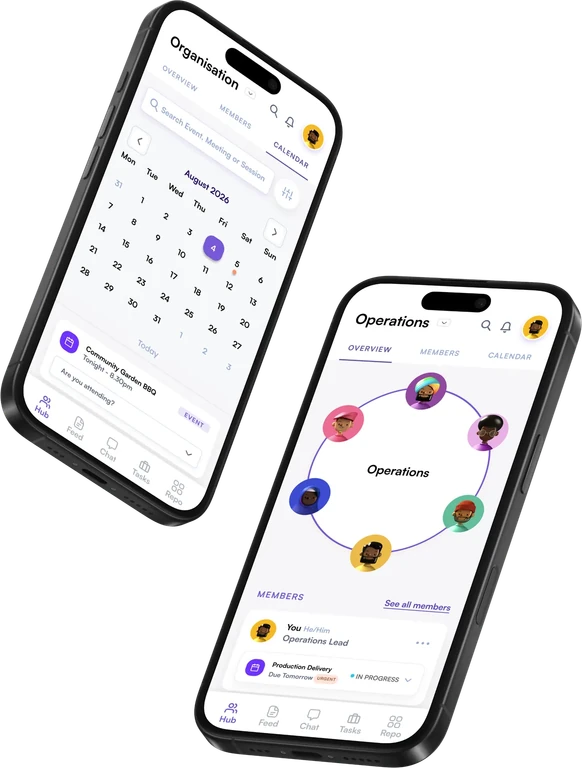
That is what Autono's Hub and Tasks are built for. Tasks can be initiated by anyone, ownership is claimed rather than allocated, and accountability is visible to the whole team rather than only upward. Lists, Kanban boards and Gantt timelines are all available, because bottom-up does not mean unplanned. Underneath them the model separates a one-time task from a recurring responsibility from a role, and those distinctions are optional in a push system, where the manager holds the difference in their head. In a pull system they are load-bearing.
If you are trying to move a team towards genuinely self-organised work and finding that your tooling keeps pulling you back towards allocation, we would like to help. Get started with Autono, or request a demo if you would rather be shown how teams are running this in practice.
For the underlying question of who is entitled to decide what, start with decision rights. If you are rolling this out across a membership rather than a single team, what belongs on a member portal covers what people need to see. For the terminology, see the governance glossary.