There is a comfortable story about groups. Put enough smart people in a room, give them the facts, and something better than any individual judgement will emerge. It is the assumption underneath every workshop, steering group and leadership offsite ever convened.
The research says something more useful than that. Groups really can outperform their best individual member, but what determines whether they do has almost nothing to do with who is in the room and almost everything to do with how the conversation is structured. That makes collective intelligence a design problem rather than a hiring problem, and design problems can be solved.
What is group decision making?
Group decision making is the process by which several people with different information, incentives and authority arrive at a single settled choice. It covers who is consulted, how disagreement is surfaced and resolved, who holds the final call, and how the outcome and its reasoning are recorded so the group does not relitigate it later.
Most organisations have a strong view on the last part of that sentence and no explicit view on any of the others, which is where the trouble starts.
Groups are smarter than individuals, but not for the reason you think
In 2010 Anita Woolley and colleagues published a study in Science that has held up well. Across 699 people in groups of two to five, they found a single factor, c, that predicted group performance across wildly different tasks: brainstorming, moral reasoning, planning, visual puzzles. It explained 43% of the variance in study one and 44% in study two.
The striking part is what c did not correlate with. Average member intelligence was not a significant predictor (r = 0.19), and neither was the intelligence of the smartest person in the group (r = 0.27). Hiring the cleverest people available does not, on this evidence, buy you a cleverer group.
What did predict it:
Factor | Correlation with collective intelligence |
|---|---|
Social sensitivity of members | r = 0.26 |
Equality of conversational turn-taking | r = -0.41 with variance in turns |
Proportion of women in the group | r = 0.23 |
Average individual intelligence | r = 0.19, not significant |
Maximum individual intelligence | r = 0.27, not significant |
The turn-taking figure is the one to sit with. It is negative because it measures variance in speaking turns: the more unevenly the talking was distributed, the worse the group performed. At the same level of individual ability, groups dominated by one or two voices did measurably worse.
That is a finding about process, not about people, and process is the one thing a group decision making system can actually change.
The failure mode: groups discuss what everyone already knows
The second piece of evidence is older and, if anything, more damning.
Garold Stasser and William Titus built what became known as the hidden profile paradigm. They gave groups a decision whose right answer could only be found by pooling information, with some facts given to everyone and others to a single member. The correct option was identifiable from the combined set and invisible from any individual's.
Groups reliably failed. Discussion gravitated to the information everyone already held, because shared information is easier to raise, gets corroborated when raised, and makes the speaker look well informed. The one fact that would have changed the answer was the least likely thing said out loud.
This is called shared information bias, and once you know about it you will see it in every meeting you attend. The discussion converges, everyone feels aligned, and the person who knew the thing that mattered never found a moment to say it. It is the single most expensive failure in group decision making, and it is invisible from the inside.
The hidden profile test. After your next significant decision, ask each participant privately: what did you know that you did not say? If you get useful answers, your process is losing the exact information it exists to surface. Structure, not encouragement, is what fixes this. "Speak up if you have concerns" has never once worked.
Note what both findings have in common. Live, verbal, real-time discussion is a poor mechanism for pooling information. It over-rewards fluency, confidence and seniority, and under-rewards the person who needs a moment to check something. This is the strongest available argument for asynchronous decision making, and it is a far better one than the usual appeal to calendar convenience.
Five ways group decision making actually happens
Most teams use one method for everything and wonder why it fits badly. Naming the options helps.
Consensus
Everyone must actively agree. Produces genuine buy-in and, on anything contested, consumes unlimited time. Works in small, high-trust groups without deadlines. Degrades into exhaustion or quiet coercion at scale.
Consent
The sociocratic alternative, and the most underrated method here. The question is not "do you agree?" but "do you have a reasoned objection?" A proposal passes unless someone can say why it would cause harm or prevent the group doing its work. Far faster than consensus, because mild preference stops being a veto while real objections still have to be heard.
Majority vote
Fast, legible, and the default in any membership organisation with a constitution. Its weakness is that it discards the reasoning along with the minority, which we come back to below.
The advice process
One named person decides, but must first seek advice from those affected and those with expertise. The advice is not binding, though the decider must show they sought it. Popularised by self-managing organisations such as Buurtzorg and Morning Star, and it scales better than most people expect.
Delegated decision with input
A role holds the authority, gathers input and decides. Much like the advice process, except the authority comes from a defined role rather than from whoever picked up the work.
Method | Speed | Information surfaced | Buy-in | Best for |
|---|---|---|---|---|
Consensus | Slow | High | Highest | Small groups, foundational choices |
Consent | Fast | High | High | Most operational governance |
Majority vote | Fast | Low | Medium | Formal resolutions, member mandates |
Advice process | Fast | High | Medium | Expert or role-specific calls |
Delegated with input | Fastest | Medium | Medium | Everyday decisions inside a role |
The practical move is to stop treating this as a cultural identity and start treating it as routing. Pick the method per decision, state it before anyone contributes, write it down. Which method applies where is a decision rights question, and no amount of facilitation substitutes for answering it.
Why team voting software is not a decision system
Teams that take group decision making seriously often reach for a vote, and the market obliges with a whole category of team voting software, most of it competent at the thing it does.
The problem is what a vote is. It takes a distribution of views, each with reasons attached, and collapses it into a number, and the number is the least informative part of what the group produced.
Three things go missing. The reasoning, so anyone who was not there cannot reconstruct why. The objections, so a serious concern is indistinguishable from mild preference. And the information, which is the hidden profile problem again: team voting software has no mechanism for surfacing the fact only one member holds, and voting earlier makes it less likely to emerge rather than more.
Arrow's impossibility theorem adds a caution. No ranked voting method can satisfy a small set of obviously desirable fairness conditions at once, which means the method of aggregation changes the winner. A tally with no record of how it was taken is weaker evidence than it looks.
What team voting software captures | What a decision actually needs |
|---|---|
The tally | The tally and the reasoning behind it |
Who voted | Who held the authority to decide |
That it closed | What would reopen it |
A result | A record a stranger can understand in a year |
Where voting genuinely earns its place
None of which is an argument against voting, and in some settings it is not optional.
A co-operative, mutual, union branch or membership association has obligations a startup does not: one member one vote regardless of shareholding, quorum thresholds that must be evidenced, formal resolutions with defined notice periods, and an auditable record that satisfies a regulator or an AGM rather than a colleague. A cooperative governance tool has to satisfy a rulebook, not a preference, and democratic governance software that cannot produce a defensible audit trail is not fit for purpose whatever else it does well.
There is a second, less obvious case for democratic governance software. An async voting tool for teams is the difference between governance that includes the membership and governance that includes whoever was free on a Tuesday afternoon. Synchronous voting systematically excludes shift workers, part-time colleagues, carers, volunteers and anyone in another timezone, and in a membership organisation that is a legitimacy problem rather than an inconvenience. Any cooperative governance tool you assess should be judged on that first.
Voting should be the closing mechanism of a good process, not a replacement for one.
What a collective decision making tool has to do
Pulling the evidence together, four requirements fall out. A collective decision making tool worth adopting does all four. Most do one or two.
Make the question decidable before anyone contributes
A question that cannot be written in one sentence with its constraint attached is not ready. "Thoughts on pricing?" produces thoughts. "Three tiers or two, given that we cannot change the underlying plans before Q4?" produces a decision.
Surface unshared information before positions harden
This is the hidden profile fix, and it is structural rather than cultural. Collect contributions in writing before revealing them, so the first confident answer cannot anchor the rest. This one change does more for group decision making quality than any amount of facilitation training.
Separate contributing from objecting
Considerations are additive and everyone can offer them. Objections are a distinct act that must be resolved before proceeding. Conflating the two produces the forty-comment thread where nobody can tell what is blocking.
Close explicitly and record the reasoning
State what was decided, why, who decided and under what authority, and what would bring it back. Written at the moment of closing this takes ninety seconds, because the material is all in front of you. Written a month later it takes an afternoon and usually does not happen, which is why most organisations cannot answer "why did we do this?" about anything more than a quarter old. That record is a decision log, and it is the only artefact from this whole process that still has value in a year.
Where group decision making lives in practice
You can run all four by hand, and disciplined teams do. The friction appears in the same three places: nobody can see which decisions are open, closing depends on someone remembering, and the record ends up in a different system from the process that produced it.
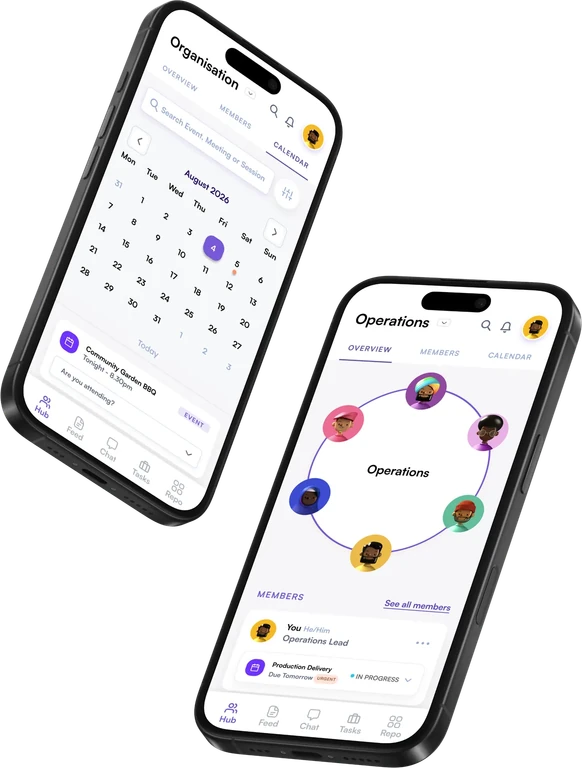
Autono exists to close that gap. Sessions run group decision making as a process rather than a meeting: a framed question, a stated decision method, written contributions gathered before they are revealed, objections held separately from considerations, and a closing time that holds. It doubles as an async voting tool for teams whose members cannot all be online at once. Closing writes the decision and its reasoning into the log as a by-product rather than a chore, and the resulting work lands in Tasks already owned, with no retyping. The Hub is where members can see all of it, which is what makes a self-managing platform legitimate rather than merely decentralised.
If you need formal voting it is there, with quorum, one member one vote and an auditable record, which is what a cooperative governance tool has to provide. If you need consent rounds, those are there too. The method is a property of the decision rather than of the product.
Where to start
Do not begin by choosing a method and announcing it. Begin with the next real decision and answer three questions before anyone contributes: what exactly is being decided, who settles it, and how. Then write down what you concluded and why.
Do that ten times and you will have a working group decision making practice, and enough evidence to know which collective decision making tool your organisation actually needs. If you want somewhere to put it, get started with Autono, or request a demo and we will walk you through a decision end to end.
For the surrounding territory, see self-management tools on structure and roles, strategic alignment tools on keeping decisions tied to objectives, and the governance glossary for the vocabulary.
Sources. Anita Williams Woolley, Christopher Chabris, Alex Pentland, Nada Hashmi and Thomas Malone, "Evidence for a Collective Intelligence Factor in the Performance of Human Groups", Science 330, 2010. Garold Stasser and William Titus, "Pooling of Unshared Information in Group Decision Making", Journal of Personality and Social Psychology 48, 1985. Kenneth Arrow, Social Choice and Individual Values, 1951.