Most organisations treat misalignment as a communication failure. The strategy was not repeated often enough, the all-hands was not clear enough, the goals were not cascaded properly. So they communicate harder: another deck, another town hall, another quarterly refresh of the same three priorities.
It rarely works, because the diagnosis is wrong. People are not misaligned because they never heard the goal. They are misaligned because they cannot see the decisions that have been quietly moving it.
What are strategic alignment tools?
Strategic alignment tools are software that keeps a team's daily decisions connected to its stated objectives. Rather than broadcasting goals downward, they make the decisions underneath each goal visible, so anyone can see what has been settled, what is still open, and how the current direction came to differ from the one announced in January.
Alignment decays at the decision layer
A strategy is not a document. It is the sum of several hundred small decisions, most of which are made by people who were not in the room when the strategy was written.
Each of those decisions is locally reasonable. A team drops a feature because a dependency slipped. Another reprioritises after a customer conversation. A third quietly redefines what "launch" means. Nobody did anything wrong, and no single move was large enough to escalate.
Six weeks later the plan on the wall and the work in flight have diverged, and the first anyone notices is the quarterly review, where it presents as a people problem. It is not. It is a visibility problem, and communicating the original goal more loudly cannot fix it, because the original goal was never the thing that changed.
A quick diagnostic. Pick the objective you are least confident about. Can you list the last five decisions that affected it, who made each one, and why? If not, you do not have an alignment problem you can solve with a better deck.
What strategic alignment tools actually have to do
Three jobs, and most products in this space do the first one only.
Connect goals to the decisions underneath them
Objectives and key results tell you the destination. They say nothing about the turns. A goal that cannot be traced to the decisions currently shaping it is a statement of intent, not an instrument of alignment.
The useful move is to attach decisions to the objective they serve, so that reading a goal also means reading its recent history.
Make group decision making visible while it happens
Alignment is cheapest to maintain before a decision closes, not after. If people can see that a question is open, who owns it and when it closes, the ones who will be affected can weigh in while weighing in is still useful.
This is where a collective decision making tool earns its place: not by gathering opinions, but by making the existence of an open question public before the answer is fixed.
Record what changed, and why
The reasoning matters more than the outcome. A team that knows a decision was made will comply. A team that knows why it was made can extend it to the next case without asking, which is what alignment is actually for.
Why team voting software alone does not create alignment
Plenty of teams reach for a vote at this point, and voting has a real place. An async voting tool for teams lets people with different schedules, timezones and shift patterns participate on equal terms, which is a genuine improvement on whoever is free on a Tuesday.
But team voting software on its own tends to produce a tally and nothing else. The result arrives without the argument that produced it, so the people who lost the vote have no way to understand the decision and the people who were absent have no way to reconstruct it. Group decision making that captures only the count discards the part that travels.
What gets captured | What alignment needs |
|---|---|
The outcome | The outcome and the reasoning |
Who voted | Who held the authority to decide |
That it closed | What would reopen it |
A notification | A record anyone can find in six months |
If you are choosing between a poll, a proposal and a full session, we have written about which format to use when. For running the process itself, see the protocol for asynchronous decision making.
Three questions to ask of any alignment tool
Worth putting to any strategic alignment tools you are shortlisting, before the feature comparison.
Can I get from an objective to its decisions in one click? If the goals live in one system and the decisions in another, the connection depends on someone maintaining it by hand, and they will not.
Can someone who missed the discussion still understand it? The test is a new joiner reading a closed decision and explaining why the alternatives lost, without asking anyone.
Does the record appear by itself? Documentation performed as a separate chore afterwards survives roughly three months. Documentation produced as a by-product of deciding survives indefinitely.
Alignment is a by-product, not a programme
The organisations that stay aligned as they scale are not the ones that communicate most. They are the ones where decisions are visible while they are being made and legible after they are made.
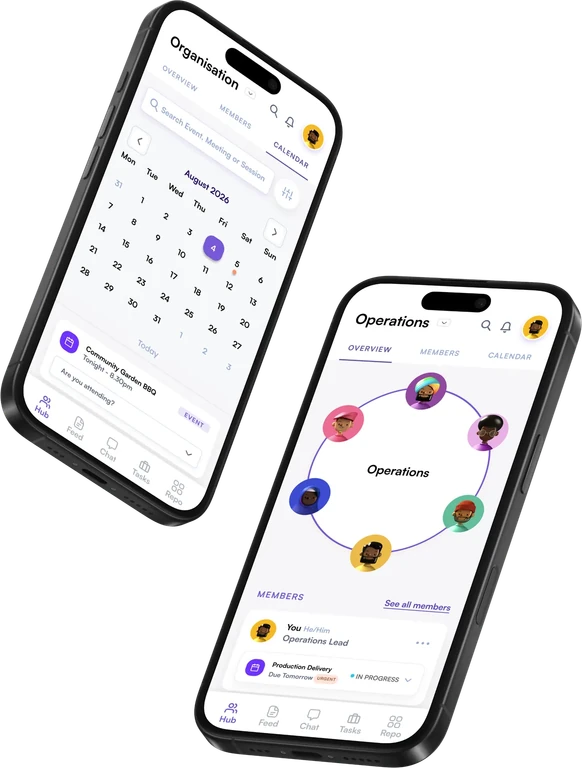
That is the principle Autono is built on. Open questions surface in Sessions where the people affected can see them, decisions close into the decision log with their reasoning attached, and the resulting work lands in Tasks already owned. Nobody has to transcribe anything for the strategy and the work to stay in the same conversation.
If your last quarterly review turned up surprises, that gap is the thing to close. Get started with Autono, or request a demo and we will walk you through it.
For the foundations underneath all of this, see what a decision log is and how to set a decision rights framework.