An organisation commits to being open by default. Salaries are published. Board papers go to everyone. Every channel is public. Every document is readable by anybody who wants it.
Two years later, a member says they had no idea a significant decision had been made, and they are right. It was entirely visible. It was in a public channel, in a document anyone could open, mentioned in a thread with fourteen participants. And it was completely invisible, because it sat inside four thousand other things that were also entirely visible.
This is the workplace transparency paradox, and it is not an argument against transparency. It is an argument that openness without structure produces a specific kind of opacity, and that the organisations most committed to being open are the ones most likely to run into it.
Workplace transparency and access are not the same thing
The confusion at the root of this is between information being available and information being reachable.
Available means nothing prevents you from seeing it. Reachable means you would plausibly encounter it, or could find it when you needed it, without already knowing it existed.
Most workplace transparency initiatives deliver availability and stop. That is the easy half: change the permissions, open the channels, publish the documents. The reachability half requires editorial judgment about what surfaces, for whom, and when, and editorial judgment feels uncomfortably close to gatekeeping in an organisation that has just committed to openness.
So it does not get done, and the result is an organisation where everything is technically knowable and very little is actually known. Which is, functionally, an organisation with secrets, except that nobody chose which ones.
The honest test. Pick a decision made in the last quarter that affects a team other than yours. Time how long it takes someone from that team to find what was decided and why, without asking a person. If it takes more than two minutes, you have availability without reachability, whatever your permissions say.
Three ways undifferentiated workplace transparency backfires
It shifts the burden onto the least resourced people
If everything is public and nothing is prioritised, staying informed becomes a research task that each person has to perform for themselves.
The people who can do this are the ones with time, context and confidence: usually long-tenured, usually central, usually at a desk. The people who cannot are new joiners, part-time members, shift workers and anyone whose role does not include reading.
So a policy intended to level access ends up concentrating it, and it does so invisibly, because the organisation can point to the permissions and say that everyone had the same opportunity. Everyone did. Not everyone had the same hour.
It creates a false sense of consultation
When a decision was visible to everyone in advance, it becomes easy to treat silence as agreement. Nobody objected, therefore nobody objects.
But silence in a high-volume environment carries no information at all. People did not object because they did not see it, and the fact that they could have seen it is not a defence anyone finds satisfying at the point they discover what happened.
This is corrosive precisely because it is well-intentioned. The organisation genuinely believes it consulted. The members genuinely experience not having been asked. Both are correct, which makes the disagreement unusually hard to resolve.
It makes real signals indistinguishable from noise
The most practical cost. When the announcement of a significant restructure sits in the same feed, in the same visual form, as a note about the coffee machine, people stop attending to the feed. Not because they do not care about the restructure but because they have learned that the feed does not distinguish, and doing the distinguishing themselves is more work than it is worth.
What to make more open, and what to structure instead
The answer is almost never less workplace transparency. It is transparency with shape.
Keep fully open | Add structure to | Keep genuinely closed |
|---|---|---|
Decisions and their reasoning | Which decisions surface to whom, and when | Individual performance conversations |
Roles and who holds them | Volume of routine updates | Personal or health information |
Policies and who owns them | Discussion that is still exploratory | Legal matters under advice |
Financial position at the level people can act on | Anything with a deadline attached | Individual pay conversations, if that is your model |
The reasoning behind pay bands and structure | Cross-team information that only some teams need | Confidential external commitments |
The middle column is where the work is. Structure here does not mean restricting access. It means making some things arrive rather than waiting to be found, giving deadlines a different weight from information, and separating decisions from discussion so that the settled things can be located without wading through how they became settled.
Four practical moves
Separate the record from the conversation. The single highest-return change. Discussion is high-volume, exploratory and mostly not worth revisiting. Decisions are low-volume, settled and constantly worth revisiting. Keeping them in the same place means the second is permanently buried under the first. A distinct decision log fixes this more thoroughly than any amount of channel discipline.
Push what has a deadline, publish what does not. If something requires a response by a date, it should reach people rather than sit waiting to be discovered. If it is context, publish it and let people find it when relevant. Conflating the two is what produces both notification fatigue and missed deadlines simultaneously.
Give things owners. An unowned document is unreachable in a subtler way: even when found, nobody knows whether it is current or who to ask. Attaching an owner and a review date to every policy costs an afternoon and roughly halves the questions.
Measure reachability, not openness. Stop reporting how many channels are public. Start timing how long it takes a member of a different team to find a specific decision. That is the number that reflects what people actually experience.
Diagram contrasting a flat undifferentiated feed with a structured view separating decisions, deadlines and discussion
The same information, structured. Nothing has been hidden; the difference is that the settled things can now be found without reading the unsettled ones.
So, how much is too much?
Workplace transparency becomes too much at the point where the cost of finding what matters exceeds the benefit of it being available. That threshold is not a fixed volume. It moves depending on how well structured the information is.
A well-structured organisation can be radically open with almost no cost, because reachability scales. A badly structured one hits the limit quickly, and its usual response is to start closing things, which is precisely the wrong correction. The problem was never the openness. It was that openness was implemented as a permissions change rather than as an information architecture.
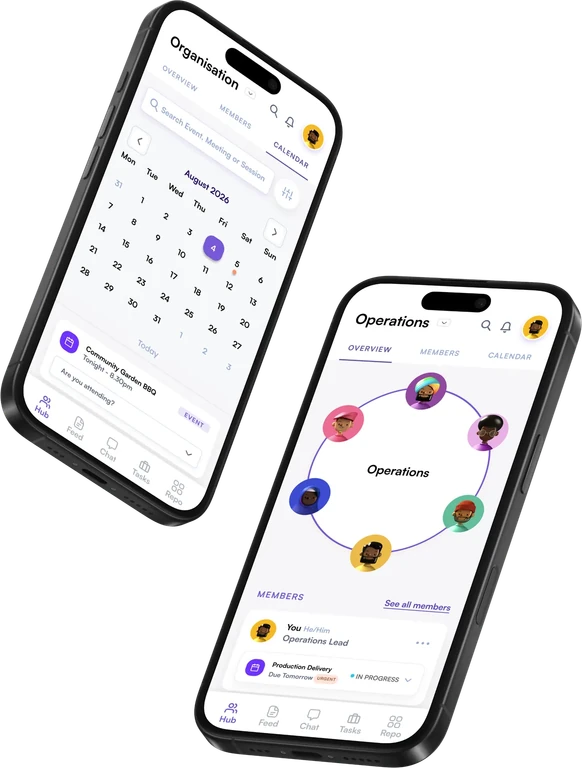
This is the design principle behind how Autono separates things: Chat for conversation, threaded by topic and organised by channel. Feed for what needs attention, in one prioritised stream rather than a flat wall. The decision log for what is settled and why. And Repo for what currently applies, with enterprise search over it. Everything is open. What differs is how it reaches you, which is the part that makes openness usable rather than merely honourable.
If your organisation is committed to workplace transparency and finding that people still miss things, the fix is probably structural rather than cultural. Get started with Autono, or request a demo if you would rather be shown what that looks like.
The two companion pieces: why nobody reads our internal announcements on the broadcast half of this problem, and choosing between a poll, a proposal and an async session on getting the format right in the first place.